Direct answer
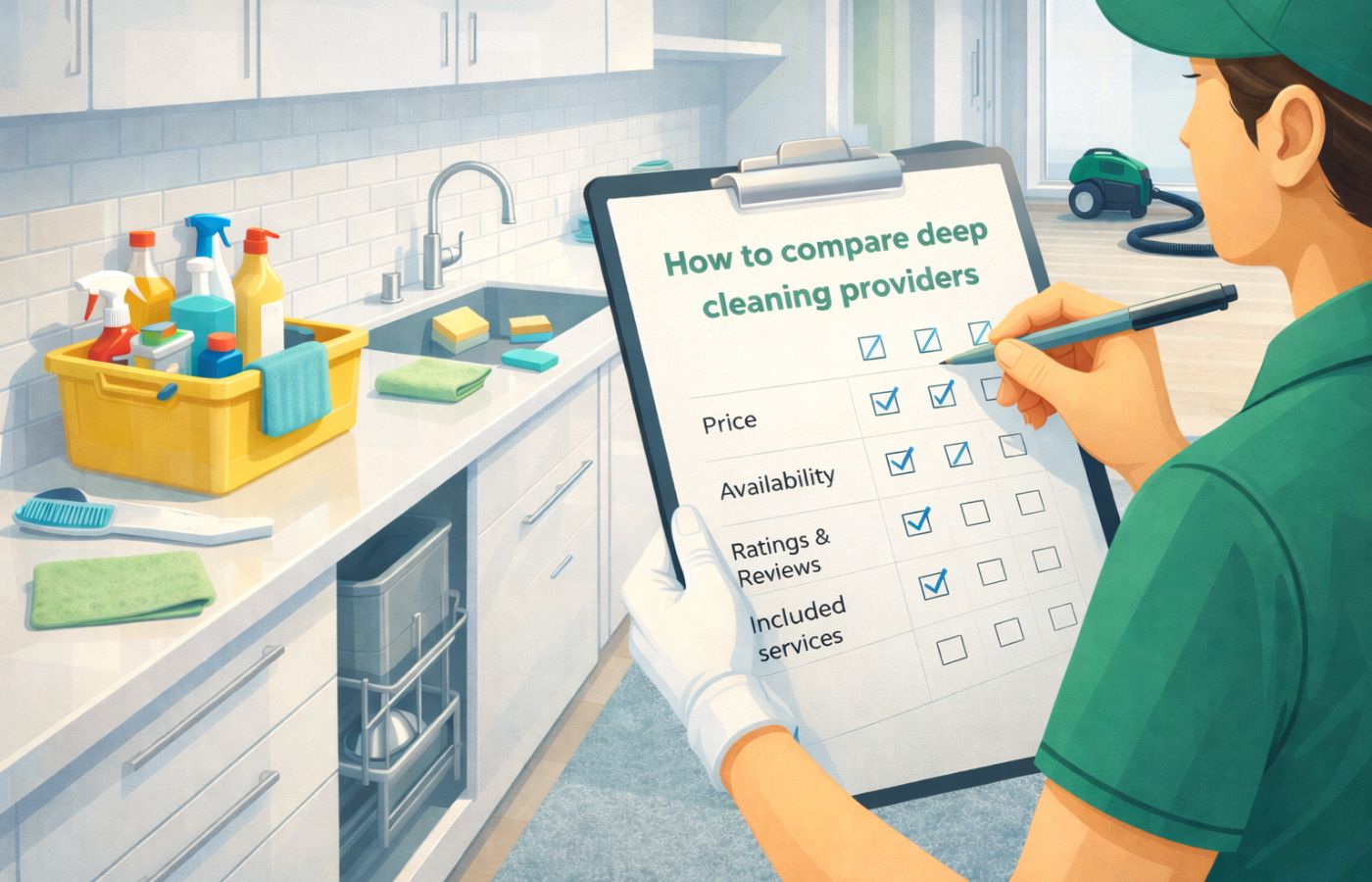
Compare deep cleaning providers by examining detailed service scopes, obtaining clear, itemized quotes, verifying comprehensive insurance coverage, evaluating verified customer reviews, confirming provider availability, and identifying any hidden exclusions or unclear guarantees. Pay special attention to whether the cleaning tasks match your specific needs, ensure pricing transparency without hidden fees, check that insurance policies cover potential damages, and assess the reliability of guarantees offered. This thorough evaluation minimizes risks and helps you select a provider who reliably delivers the cleaning services you require.
Quick checklist
- Verify the provider’s experience and reputation in deep cleaning services.
- Ask for proof of relevant insurance and any credentials required for the specific task; compare each provider's written scope and terms.
- Compare the scope of services included in each provider’s deep cleaning package.
- Request detailed pricing and confirm there are no hidden fees or extra charges.
- Assess customer reviews and testimonials for quality and reliability feedback.
- Confirm availability and flexibility to match your scheduling needs.
Requirements and materials
- Item: Service provider profiles. Used for: gathering detailed information about each deep cleaning company. Outcome: enables accurate comparison of services, pricing, and reputation.
- Item: Cleaning scope checklist. Used for: defining the specific areas and tasks to be covered in the deep cleaning. Outcome: ensures all providers are evaluated on the same requirements.
- Item: Customer reviews and ratings. Used for: assessing past client satisfaction and service quality. Outcome: helps identify reliable providers and avoid poor experiences.
- Item: Pricing and contract terms. Used for: comparing costs, payment conditions, and service guarantees. Outcome: supports informed decisions balancing value and budget.
Comparison and decision matrix
- Option: Standard deep cleaning provider. What it means: Offers routine deep cleaning services with general equipment and trained staff. Recommended approach: Choose for regular maintenance and moderate cleaning needs. Watch-out: May lack specialized equipment for tough or delicate surfaces.
- Option: Specialized eco-friendly provider. What it means: Uses environmentally safe products and methods tailored to sensitive environments. Recommended approach: Select when sustainability and non-toxic cleaning are priorities. Watch-out: Can be more expensive and may require longer cleaning times.
- Option: Premium expert service. What it means: Provides advanced cleaning techniques, including disinfection and restoration by certified professionals. Recommended approach: Ideal for high-risk areas or after contamination events. Risk: Higher cost and scheduling complexity compared to standard services.
Step-by-step process
- Action: Gather provider information. Object: deep cleaning service options. Method: research online reviews and service details. Outcome: creates a comprehensive list for comparison.
- Action: Define cleaning requirements. Object: cleaning scope and frequency. Method: list specific needs and priorities. Outcome: ensures relevant provider features are evaluated.
- Action: Request detailed quotes. Object: selected providers. Method: contact providers for pricing and service breakdowns. Outcome: obtains comparable cost and service data.
- Action: Evaluate service inclusions. Object: cleaning tasks and materials. Method: compare provider offerings against requirements. Outcome: identifies best fit for cleaning needs.
- Action: Check provider credentials. Object: insurance and task-specific qualifications. Method: verify relevant documents and the written service terms. Outcome: helps identify a suitable provider without assuming a general cleaning licence is required.
- Action: Review customer feedback. Object: past client experiences. Method: analyze testimonials and ratings. Outcome: assesses reliability and quality of providers.
What to avoid
When learning how to compare deep cleaning providers, avoiding unsafe shortcuts and assumptions is crucial. Using unreliable methods or ignoring key factors can lead to poor decisions, wasted resources, and unsatisfactory results. Careful evaluation ensures you select a provider that meets your needs effectively and safely.
- Avoid: Choosing providers based solely on lowest price. Why it is risky: This can compromise quality and lead to hidden costs. Safer alternative: Evaluate service scope and reputation alongside pricing.
- Avoid: Assuming every cleaner needs the same licence or certification. Why it is risky: Requirements vary by task. Safer alternative: Check relevant insurance, task-specific qualifications and the written scope before deciding.
- Avoid: Relying only on online reviews without direct communication. Why it is risky: Reviews can be biased or outdated, missing current service quality. Safer alternative: Contact providers directly to ask detailed questions.
- Avoid: Overlooking contract terms and cancellation policies. Why it is risky: Unfavorable terms can cause unexpected fees or inflexibility. Safer alternative: Read and understand all contract details before agreement.
Common mistakes and risks
- Failing to verify credentials causes hiring unreliable providers and leads to poor cleaning results.
- Ignoring detailed service comparisons creates misunderstandings and increases the risk of hidden fees or inadequate services.
- Relying solely on price leads to choosing low-quality providers and causes unsatisfactory cleaning outcomes.
- Skipping customer reviews and references increases the chance of selecting providers with poor reputations and damages trust.
Scenario-specific guidance
When learning how to compare deep cleaning providers, consider your specific scenario. For residential cleaning, prioritize providers with flexible scheduling and eco-friendly products. Commercial settings may require providers with certifications and insurance. Budget constraints might lead you to compare service packages closely, while urgent needs call for providers with rapid response times. Additionally, material types and surface sensitivities affect provider suitability, so check their expertise accordingly.
Typical ranges and decision points
When learning how to compare deep cleaning providers, typical ranges and thresholds offer practical guidance but vary by context such as property size, cleaning scope, and location. These values should be used as flexible decision points rather than fixed guarantees. Understanding what affects each range helps you interpret quotes and service terms effectively, and knowing the appropriate action when values fall outside normal ranges ensures better provider selection.
- Range: Price range. Compare quotes within 15% to 30% variance. Affected by: property size, cleaning scope, materials used, and regional labor costs. Action: Request detailed breakdowns if price differs by more than 20%.
- Time span: Quote validity. Typically valid for 7 to 21 days. Affected by: provider availability, seasonal demand, and material costs. Action: Confirm expiry date before booking to avoid unexpected price changes.
- Trigger: Availability window. Providers usually offer 1 to 3 available dates within a 2-week period. Affected by: booking lead time, team size, and access constraints. Action: Consider alternative providers if timing does not meet your schedule.
- Threshold: Review threshold. Look for at least 3 recent reviews mentioning deep cleaning quality and reliability. Affected by: review recency, job similarity, and complaint patterns. Action: Treat providers with repeated negative feedback as high risk.
When to seek expert help
You should seek expert help when you are unsure how to compare deep cleaning providers effectively, especially if the cleaning involves specialized materials or high-value assets. If the scope of cleaning is complex or if you encounter conflicting service offers, consulting a professional can ensure you make informed decisions. Additionally, when compliance, safety, or health standards are critical, an expert’s guidance is essential to avoid costly mistakes. If you find it difficult to evaluate providers based on quality, pricing, or service guarantees, it is advisable to get specialist advice to protect your interests and achieve the best outcome.